Umbra
202406271727
Status: #idea
Tags: e6data
Umbra
- Modify LeanStore (the buffer manager) to support variable size pages
- Page sizes start at 64KiB and double. No upper bound
- Buffer pool is allowed to use upto half of total system memory
- No need to specify the amount of memory for each page size
2.1 - Buffer Pool Memory Management
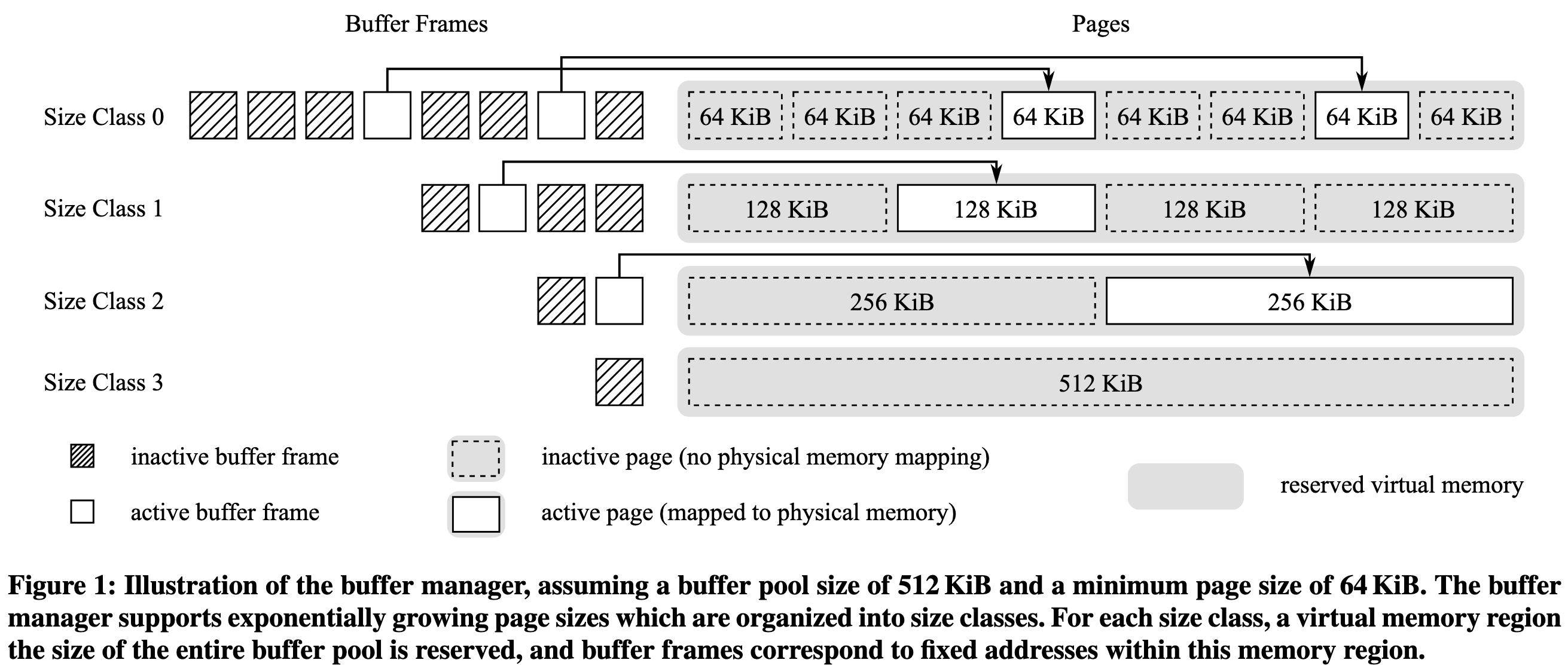
mmapto create a mapping which reserves a contiguous chunk of virtual memory. No physical memory is consumed- These regions are partitioned into page-sized chunks. Ref. Figure 1
- When buffer frame is active,
preadis used to read data from disk to memory - When buffer becomes inactive, we write changes using
pwriteand allows kernel to immediately reuse the memory - Cooling pages are placed in a FIFO queue, and evicted when they they reach the end
2.2 - Pointer Swizzling
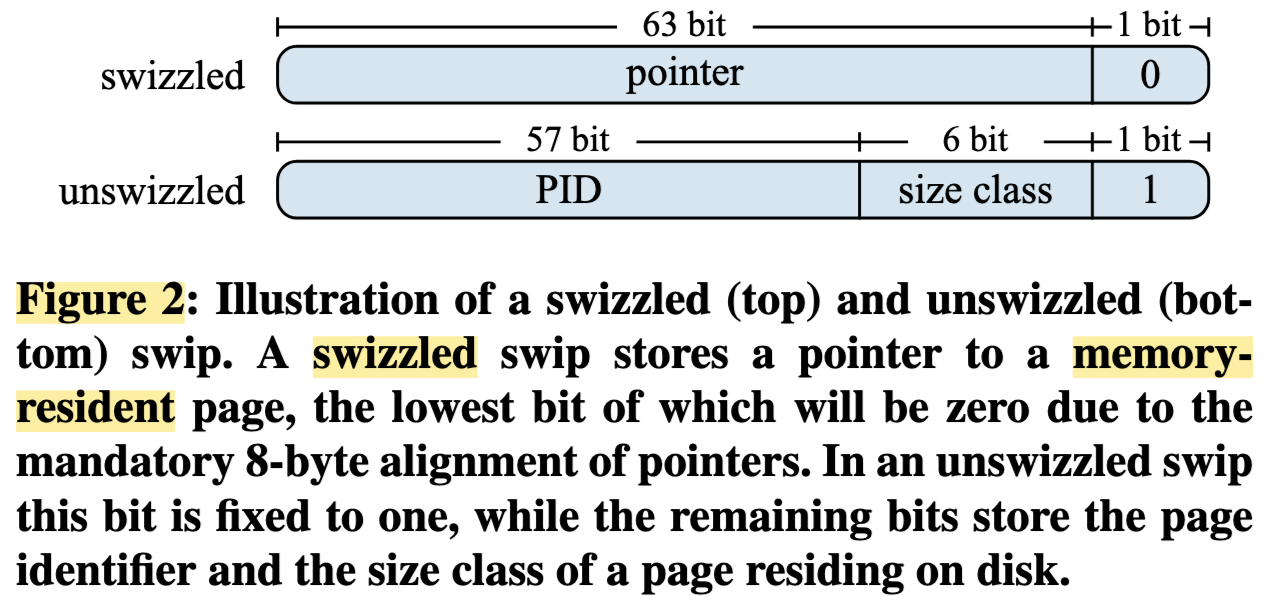
- Since references to pages are now decentralised, page eviction is more complicated
- Uses a
-tree to store swip hierarchy
2.3 - Versioned Latches
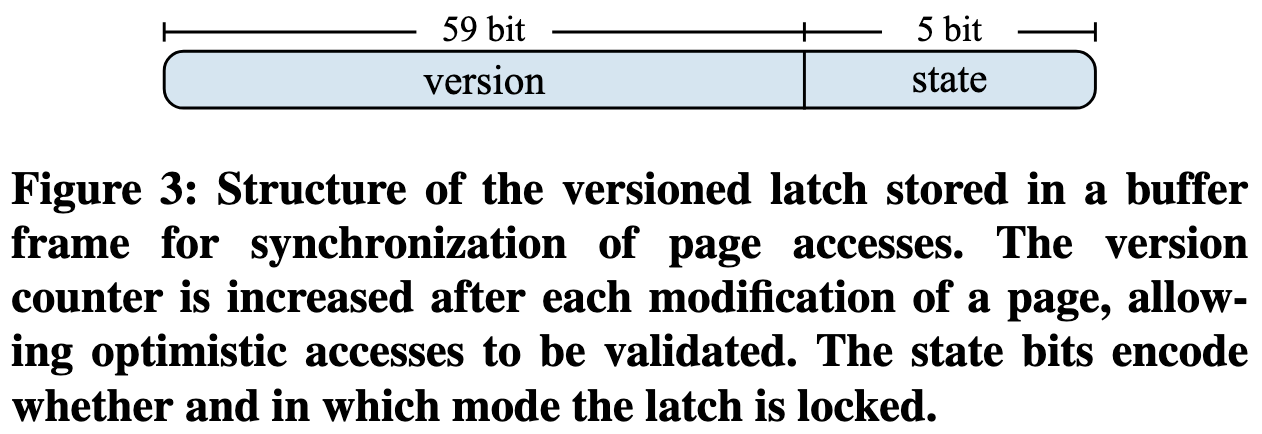
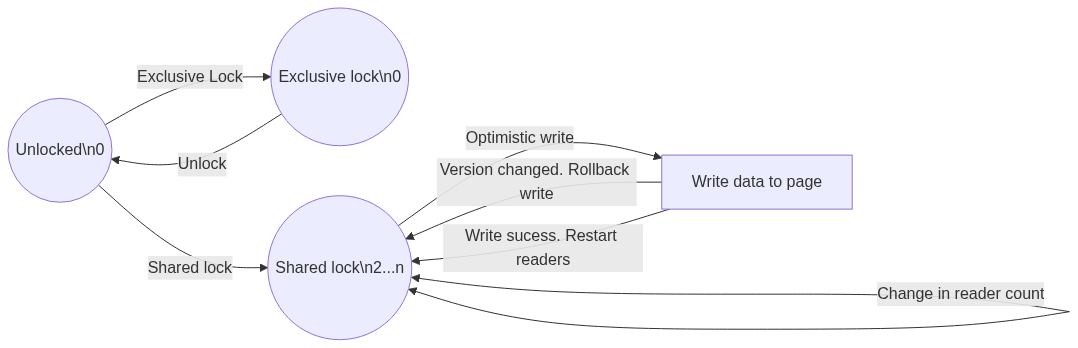
- RW lock and R-lock (allows multiple readers)
- Uses optimistic latching, i.e. every thread makes changes, and rolls back if lock is unavailable
2.4 - Buffer Managed Relations
- Relations are stored in
-trees, with synthetic 8-byte tuple identifiers as keys - Insertions
- Tuple ID’s increase monotonically to avoid splitting the nodes during insertions
- As a consequence, arbitrary insert patterns are handled equally well
- Smallest page size that can fit the tuple is chosen
- Tuple ID’s increase monotonically to avoid splitting the nodes during insertions
- Tuples in a leaf page are column-major
- Fixed size attributes are stored at the stage of the page
- Variable size attributes are stored densely at the end of the page
- This data layout is not optimal for disk.
- Future work is to integrate alternative storage layouts (like DataBlocks) for cold parts of the data
- Each page has one owning swip
- In order to prevent full traversals of the three, an optimistic latch is maintained on the parent of the current leaf node during current table scans
Conclusion
- Looks the buffer manager seems to be great. Has a good number of optimisations, which refer to other papers.
- Look into LeanStore for more details about buffer manager. Look into DataBlocks for on-disk storage format.
- Test is run on a single SSD. However, this is more relevant, especially if we plan to use a burst buffer for spills.